> ## Documentation Index
> Fetch the complete documentation index at: https://docs.risingwave.com/llms.txt
> Use this file to discover all available pages before exploring further.
# Maintain wide table with table sinks
> This guide introduces how to maintain a wide table whose columns come from different sources. Traditional data warehouses or ETL use a join query for this purpose. However, streaming join brings issues such as low efficiency and high memory consumption.
In some cases with limitation, use the [CREATE SINK INTO TABLE](/sql/commands/sql-create-sink-into) and [ON CONFLICT clause](/sql/commands/sql-create-table#pk-conflict-behavior) can save the resources and achieve high efficiency.
## Merge multiple sinks with the same primary key
```sql theme={null}
CREATE TABLE d1(v1 int, k int primary key);
CREATE TABLE d2(v2 int, k int primary key);
CREATE TABLE d3(v3 int, k int primary key);
CREATE TABLE wide_d(v1 int, v2 int, v3 int, k int primary key)
ON CONFLICT DO UPDATE IF NOT NULL;
CREATE SINK sink1 INTO wide_d (v1, k) AS
SELECT v1, k FROM d1;
CREATE SINK sink2 INTO wide_d (v2, k) AS
SELECT v2, k FROM d2;
CREATE SINK sink3 INTO wide_d (v3,k) AS
SELECT v3, k FROM d3;
```
`ON CONFLICT` only controls how `INSERT` and `UPDATE` events are handled. By default, `CREATE SINK ... INTO` forwards `DELETE` events as well. If any upstream deletes a row with a given primary key, the corresponding row in the wide table will be deleted.
To prevent `DELETE` events from removing rows in the wide table, force the sink to be append-only:
```sql theme={null}
CREATE SINK sink1 INTO wide_d (v1, k) AS
SELECT v1, k FROM d1
WITH (
type = 'append-only',
force_append_only = 'true'
);
```
For RisingWave v2.6 and earlier, you must set `type = 'append-only'` and `force_append_only = 'true'` for this pattern.
## Enrich data with foreign keys in Star/Snowflake schema model
With star schema, the data is constructed with a central fact table surrounded by several related dimension tables. Each dimension table is joined to the fact table through a foreign key relationship. Given that the join key is the primary key of the dimension tables, we can rewrite the query as a series of sink into table.
```sql theme={null}
CREATE TABLE fact(pk int primary key, k1 int, k2 int, k3 int);
CREATE TABLE d1(pk int primary key, v int);
CREATE TABLE d2(pk int primary key, v int);
CREATE TABLE d3(pk int primary key, v int);
CREATE TABLE wide_fact(pk int primary key, v1 int, v2 int, v3 int)
ON CONFLICT DO UPDATE IF NOT NULL;
/* The main sink controls which rows exist in wide_fact. */
CREATE SINK fact_sink INTO wide_fact (pk) AS
SELECT pk FROM fact;
/* Dimension sinks are force-append-only to avoid propagating DELETE into the wide table. */
CREATE SINK sink1 INTO wide_fact (pk, v1) AS
SELECT fact.pk, d1.v
FROM fact JOIN d1 ON fact.k1 = d1.pk
WITH (
type = 'append-only',
force_append_only = 'true'
);
CREATE SINK sink2 INTO wide_fact (pk, v2) AS
SELECT fact.pk, d2.v
FROM fact JOIN d2 ON fact.k2 = d2.pk
WITH (
type = 'append-only',
force_append_only = 'true'
);
CREATE SINK sink3 INTO wide_fact (pk, v3) AS
SELECT fact.pk, d3.v
FROM fact JOIN d3 ON fact.k3 = d3.pk
WITH (
type = 'append-only',
force_append_only = 'true'
);
```
The example above and the following SQL with left join operation are completely equivalent.
```sql theme={null}
CREATE MATERIALIZED VIEW wide_fact AS
SELECT fact.pk, d1.v v1, d2.v v2, d3.v v3
FROM fact
LEFT JOIN d1 ON fact.k1 = d1.pk
LEFT JOIN d2 ON fact.k2 = d2.pk
LEFT JOIN d3 ON fact.k3 = d3.pk
```
But maintaining wide table with table sinks can save the resources and achieve high efficiency.
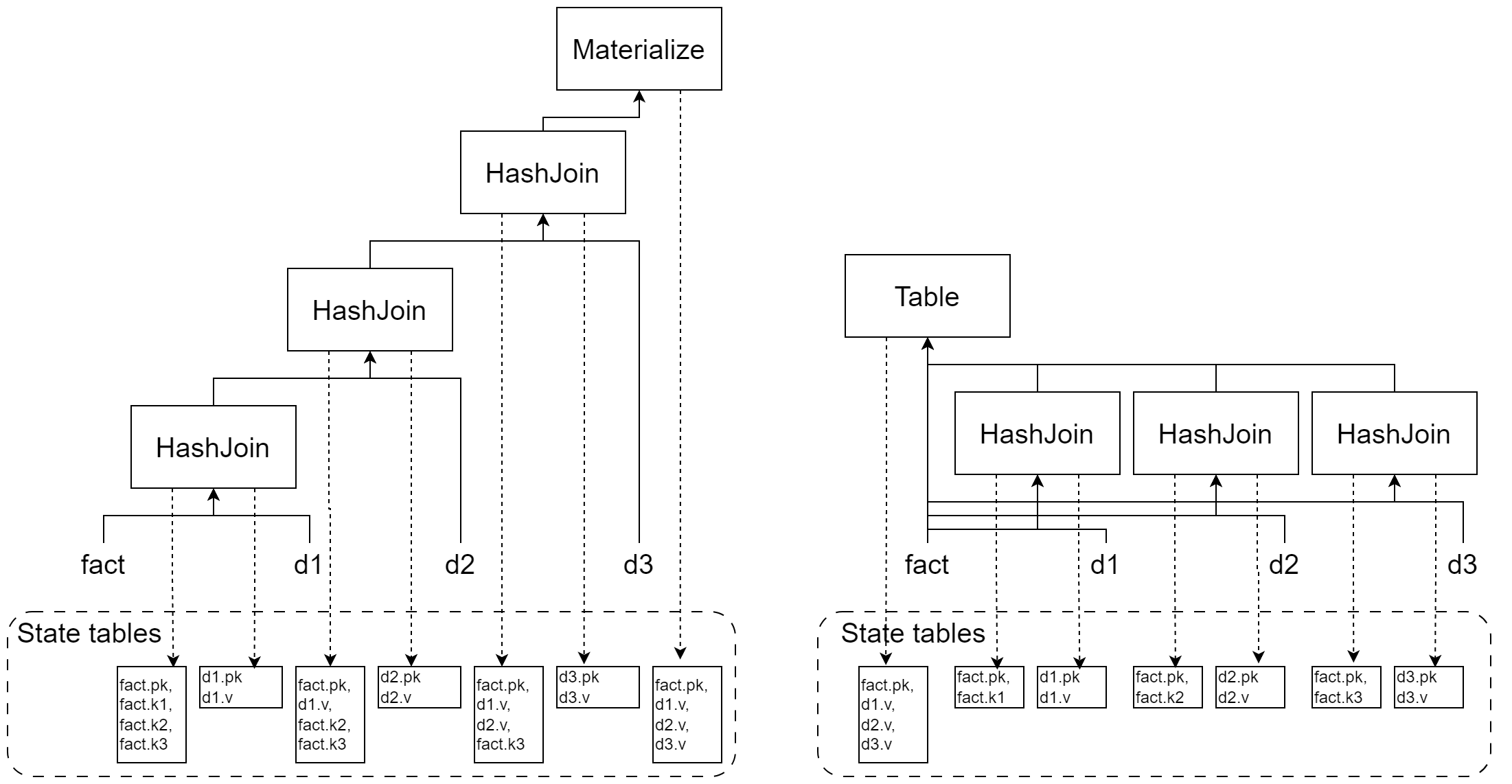 Furthermore, for the large dimension table, we can use [Temporal Join](/processing/sql/joins) as the partial join to reduce the streaming state and improve performance.